History of calculatorsCalculators have been essential tools for humans for thousands of years, helping simplify arithmetic, record-keeping, and complex computations. From ancient counting devices to modern digital calculators, their evolution reflects the progress of human innovation and technology. The history of calculators demonstrates human ingenuity in solving numerical problems. From the ancient abacus to today’s digital and graphing calculators, each advancement made calculations faster, more accurate, and more accessible. Calculators continue to evolve, integrating with modern technology and shaping the way we compute in the digital age. A calculator is a machine designed to simplify and improve calculation operations. But it is difficult to say when the calculator first appeared in history, since humans have been counting since the dawn of humanity. Originally, they counted with their fingers, and then they created tools to manage these calculations. It can be said that the first calculator was invented in the 16th century. It was mechanical, and over time, others were invented. First mechanical, then electromechanical, and towards the end of the 19th century, electronic as well. There are different types of calculators, from the simplest ones with only the four arithmetic operations (+, -, x, ÷) to scientific calculators, graphical or otherwise, for calculating square roots, exponents, etc. There are also programmable calculators, which can be programmed in a similar way to a computer. |
Before the first mechanical calculatorStarting in prehistoric times, when early humans used basic counting methods to count quantities such as food and animals. Continuing with the Egyptians, towards the end of prehistory. The Egyptians used hieroglyphic symbols to represent numbers, employing a decimal numeral system based on the number 10 (1, 10, 100, ...). The Greeks, also part of the late prehistoric period, emphasized geometry, algebra, calculus theory, and theorems such as the Pythagorean theorem. They created the first non-mechanical calculator, called the Greek abacus. This was a table covered with sand on which they drew Greek numerals to perform arithmetic calculations. During Antiquity, the Romans developed the abacus, replacing sand with columns and pebbles.Mechanical calculatorsThe first calculating machine appeared in 1645: the Pascaline. Invented by French mathematician Blaise Pascal, it was designed to perform addition and subtraction. It was intended to help his father, a tax collector, perform complex calculations more quickly and accurately. The Pascaline worked by means of a crank that turned the wheels and gears inside the machine.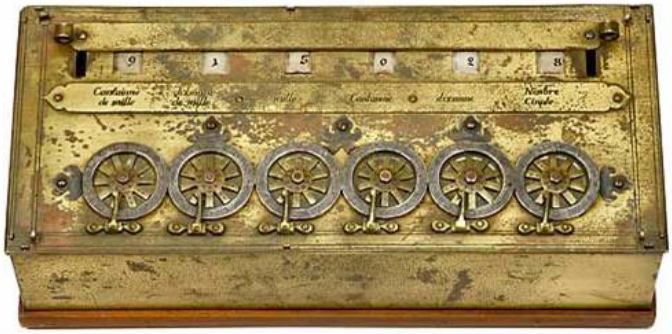
Other inventors, such as the German mathematician and philosopher Gottfried Wilhelm Leibniz, also invented similar machines around the same time, this one for multiplying, where a moving part shifts one degree to the left each time (as for manual multiplication). In 1820, the first industrial calculating machine, the arithmometer, was invented by Thomas de Colmar. It was marketed in 1851 and included the calculation of square roots in its instruction manual. Around 1850, the Difference Engine was invented by the English mathematician and inventor Charles Babbage, designed to calculate polynomials and compile tables of results. This calculator could not be built at the time due to financial difficulties. However, between 1990 and 2000, the Science Museum in London built two working examples of this machine. In 1948, Curt Herzstark invented the Curta, capable of performing the four basic arithmetic operations and square roots. This portable calculator consists of a cylindrical body and a small crank, making it resemble a pepper or coffee grinder. |
Electromechanical calculatorsThe main advance in electromechanical calculators was the replacement of the hand crank on mechanical machines with an electric motor. This motor made calculations faster and easier to understand.Around 1963, only Olivetti and Remington had marketed an electromechanical calculator. The Olivetti Divisumma 24 and the Remington Pringtime both needed only a few seconds to perform addition, subtraction, and multiplication, but division took 10 to 20 minutes, so they weren't very fast. Electronic calculatorsElectronic calculators represent a major milestone in the history of computing. Unlike mechanical and electro-mechanical calculators, electronic calculators use electronic circuits to perform calculations, allowing for faster, more accurate, and more complex operations.Electronic calculators first appeared in the 1960s, driven by advances in transistors and semiconductor technology. Early models replaced gears and moving parts with electronic components, significantly reducing mechanical wear and calculation time. The 1970s marked the rise of pocket electronic calculators. Companies like Texas Instruments, Casio, Sharp, and Hewlett-Packard became industry leaders. |